Friday, January 15, 2016

The Magic Color Series - Caught Red-Handed

Welcome back, for the penultimate installment of the Magic Color series!

Two weeks ago, I wrote the third post in this series on the color black, which is a fairly well-defined color in terms of its identity, but also a color on which I have many mixed feelings. This week, we'll be talking about red, which is a much simpler color in most respects.
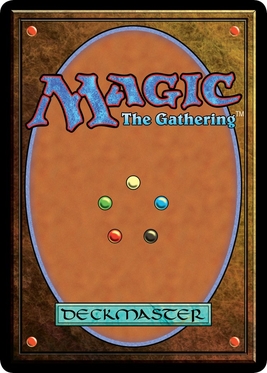

Bottom left of the color pie!

I know I've described the color pie in most of these articles, but one thing I neglected to mention is that the positioning of the colors on the circle is actually relatively important. For any color - let's take red, for instance, for obvious reasons - the two adjacent colors are known as its "allied" colors, while the other two would be its "enemy" colors. So red's allied colors are green and black, while its enemy colors are white and blue. This is representative of similarities and differences in terms of gameplay, but more importantly, in terms of theme. Black is allied with blue because omnipotence (black's main goal) and omniscience (blue's main goal) are often two sides of the same coin. However, black is enemies with white because black has a focus on selfishness, while white typically espouses selflessness. It's not a super relevant idea when I'm just talking about each individual color, but if we were to discuss multicolored decks, then it becomes much more important.

So with that, let's continue on and talk about red!


What does red represent?

I mentioned in one of the earlier posts that the colors often (but not always) coincide with the classical elements of earth, wind, fire, and air. As you could probably guess by now, red is most closely related to the element of fire, and many of the things that fire represents. Fire is often a powerful element, but it also is the element of emotion and passion and chaos, which are all pretty close to the heart of what red represents. Red doesn't like order, and red doesn't like restrictions. Red prefers to have no limits, and to do whatever comes naturally to it. It's a whimsical color, and I mean that as "capricious" and not "fairies dancing in a meadow."
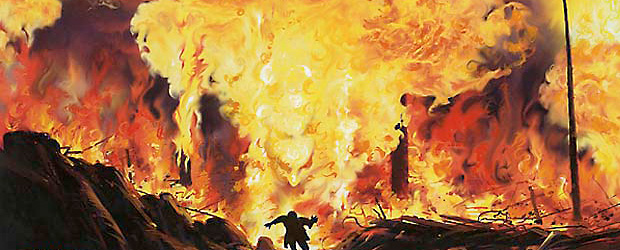

See? Whimsical.

While red is most closely related to fire, it also represents lightning and earth in many cases - both of these in a rather violent sense. Lightning is represented in terms of its powerful and capricious nature, while earth is usually depicted in an explosive sense. It's never stability and durability with red, but rather explosions and earthquakes and volcanoes. Along with these ideas, as you could imagine, red does have many ties to nature, probably second only to green. But where green focuses on growth and the ferocity of nature's creatures (more on that two weeks from now), red is focused more on nature's capacity to be violent and random.

What does this mean for gameplay?

So how does red represent these themes in-game? The most important thing to remember about red is that it's the color of emotion, and it craves freedom and doing whatever comes naturally. That means that for red, the simplest solution is usually the correct one. How does one win a game of Magic? Generally by reducing the opponent to zero life. How does one reduce an opponent to zero life? Well, the simplest way is by dealing damage. Just... damage. Red is the biggest proponent of just throwing out spells that deal some amount of damage to a creature or player - or perhaps more appropriately, dealing some amount of damage to all creatures or players. It's also the color that most enjoys destroying artifacts. Essentially, red can be summed up with "Is it annoying? Do we not like it? Let's blow it up." 


Again, red is a simple color. It doesn't need much explanation.

In terms of its creatures, there are a few trends that red follows. First off, like white, red is prone to having a lot of very small creatures charging at the enemy, whether that takes the form of an angry mob of ordinary humans or a horde of reckless goblins. Larger creatures in red often have very high power with a low toughness - in other words, they deal a lot of damage (read above), but die quickly. Elementals, minotaurs, and giants often fall into this category. These creatures often come with the haste ability, meaning they can attack on the turn they are played. Just like with red spells, red creatures are violent and capricious, and if you're playing against a red opponent, you're just as likely to be hit with a fireball as to be attacked by a rock elemental without warning. But as quickly as they appear, they're gone - if something red has decided to kill you, it's probably not thinking about its own survival.

And of course, we can't forget red's signature creature. Where black has the support of demons (if it can truly be called support), red has the power of dragons at its command. Dragons are like the epitome of red's philosophies, especially those regarding the violence of nature. So while a red deck's early creatures often focus on a horde of weaklings, it's not uncommon to see such a deck finish off the opponent by swooping in with a powerful dragon or two.


If you were looking for a sign to play a red deck...
...this is it.

Finally, another thing red is really known for is its randomness and chaos. As such, red is often where you'll find cards that ask you to flip a coin to determine which of two possible outcomes will occur, or you'll find a creature that attacks an opponent at random (which is really only applicable in multiplayer games, but still). This isn't really a majority of red cards, but it happens significantly more in red than in any other color. My favorite is Possibility Storm, which essentially replaces any spell you cast with another random spell of the same type from your deck.


Yeah, as much as red is a "simple" color, things can get
real complicated, real fast.

My opinions on the color:

So red is actually one of my less-preferred colors in the game. Not because I don't like it, per se, but personally, I like to play a very creature-heavy game. If I can swing with a creature for 20 damage at a time, I'm happy. And when it comes to big stompy creatures, my preference is for green over red, if only because I like my creatures to have a high toughness in addition to a high power. Red certainly has more options than green in terms of its non-creature spells, but I'm not as big on non-creature spells.

The other thing I don't really like about playing red is that it can be pretty boring on its own, at least to me. I like red with other colors, but not really on its own - to be fair, though, I have that complaint about most colors. Oftentimes, a mono-red deck is concerned only with winning the game as quickly as possible, and it can be a very polarizing game - either you have a good start to the game and win in about 5 turns, or you don't have a good start and there's nothing you can do to come back from it. To me, it's just not as interesting of a game as if you were playing, say, blue or black, and even if you have a rough start, you have the tools to manipulate the game to your advantage.

So overall, I personally am not a huge fan of playing red. However, I do quite enjoy the color when I do choose to play it, especially when making use of the chaotic and random cards like Possibility Storm or when combining it with colors like white or blue. And besides, who wouldn't want to dominate the game with a dragon or several, when it comes down to it?



The last article should be coming up in two weeks! To read more about red's place in the color pie, a series of articles was written by Mark Rosewater, Magic's current head designer, on the subject of the color pie. Which is really where I got a lot of my information about the colors anyway. You can find his article about red by clicking here.

Friday, January 8, 2016

The Makings of a GM: The GM's Role

Hey everyone! I know I've spoken about RPGs in previous posts (actually quite a few times already), but as of now, I'm actually quite new to the RPG world. So as a bit of background, my first ever experience with an RPG - minus a brief D&D starter pack thing I tried with my brother when I was probably about 12 - was an Apocalypse World campaign that a friend of mine ran two years ago in the spring. It was a lot of fun, but it only lasted two or three sessions. Still, it was enjoyable enough that when another friend said he would be starting up a Pathfinder game after that summer, I was willing (even if I wasn't overly excited) to join in.

As it turned out, I really became hooked, and two campaigns later, I found myself running my own games. And while I do quite enjoy playing the game, I also very much enjoy running the game as the GM - in fact, I'm not really sure which one I prefer. (I have decided to normalize my posts and only use the term "GM," rather than "DM," since it's a bit more general.) Since it's something I like to do (and I like to think I'm pretty decent at it), I figured I'd make a few posts about my philosophies when it comes to running an RPG, starting with the GM's role in the game.

So over the past few years, I've seen and played in several different RPG campaigns, each with different GMs. And when you play in multiple campaigns, you quickly notice that every GM has a different style. What I've determined is that there are two main philosophies behind the GM's role in a game, so I'll talk about those two broad ideas and which one I prefer. There is no "right" way to GM, of course - these are all just my opinions on the topic. Feel free to disagree with me - I'll only dislike you a little.


Style 1: The GM vs. the Players

The first style of GMing is what I like to call "the GM vs. the players." Essentially, the way this works is that the GM is the villain of the story. And in many ways, this is always the case regardless of your GM style. The GM is the one playing as the NPCs, of course, and that includes any monsters and villains and Big Bad Evil Guys (BBEGs for short). The GM is the one making all the dice rolls for those monsters, too, so when your ranger gets hit with the orc's greataxe for 13 damage, that's mostly the GM's fault. But while this is going to be true in any RPG, this antagonism is the goal in the "GM vs. the players" style. The GM throws monsters and traps and challenges at the players in an attempt to kill their characters, and it is up to the players to overcome these challenges and emerge victorious.


Basically this.

There are pros and cons to each style, of course. With the "GM vs. players" style, I feel that it provides a real challenge to the players, which is generally a good thing. The story and such are important, but if there's no real threat of death for the player characters, the players probably won't be having too much fun. It's like playing Skyrim on the easiest difficulty settings when you've already gone through and beaten Dark Souls four times - it'll be fun for a while, but eventually it will get boring. So in this regard, this GM style works really well. Of course, if you accidentally overtune an encounter, or the players get bad dice rolls, your challenge may turn out to be much more difficult than you'd intended, and that can feel unfair for the players as well. So there is a balance that needs to be struck (and this, of course, applies to GMing in general, but especially for this style).

The major downside I see to this GM style is that it can lead to mistrust between the GM and players, in particular on the part of the players. Let's say one of your players is playing a wizard and casts a sleep spell on the BBEG, and you know that if the BBEG goes to sleep, your campaign will end in a most anticlimactic manner. So instead, you say that the villain succeeds on his Will saving throw, and he stays awake. If you typically run the "GM vs. the players" style, your players may have a knee-jerk reaction of "What?! You can't do that!" and they may accuse you of cheating for the sake of killing off players. Essentially, when you run a game like I described above, you run the risk of players getting bitter when they feel you have done something unfair. (There are ways to avoid this, of course, but you'll have to bear with the mediocre example. You know what I'm trying to say.)


Style 2: The GM with the Players

This style of GMing has a slightly different spin on things. In this style, you can think of the GM as a facilitator rather than as an opponent - the GM and the players work together to create a cohesive and interesting story. The GM still plays all the NPCs and monsters, of course, and is still working to provide a fun and challenging experience for the players, but a total party kill is not his main goal. In fact, oftentimes, if a GM prefers this method of running a game, they may avoid a total party kill at all costs, even using deus ex machina to work around it. In other words, when the GM sees that the evil wizard's fireball will annihilate the entire party, she might have an NPC show up just in the nick of time and counter the spell so that nothing happens. Now again, that's an extreme example, and there are risks associated with that too.


I couldn't find a relevant picture, so here's a platypus.

There are some definite upsides to using this method of GMing. First off, it tends to be a story-focused game, with a bigger emphasis on roleplaying than on things like combat, which can be tedious if done poorly. But more importantly, I think it fosters a sense of trust between the GM and players - if the players know that the GM isn't out to get them, they'll be more willing to do things like split up the party to go explore the scary-looking cave AND the wizard's tower, which can make things more fun. One of the best sessions I ever ran was in a two-person Pathfinder game - one of my players wanted to take a shortcut through a swamp, while the other player wanted to take the long road around, so they split up. Now, a GM using Style 1 may have kept the swamp combat - originally meant for 2 players - at the same difficulty, thereby probably killing the player who decided to go through the swamp alone. Instead, I just changed up some numbers on the fly, and ended up with a really cool and challenging combat, but one that was still possible.

Now as for the downsides, well, as I alluded to earlier, if you're not careful with the "GM with the players" style, you run the risk of removing the challenge from the game, which can take out a lot of the fun. If the players think the GM will never kill their characters, then what's stopping them from trying to get in a slap-fight with a dragon just to see how it goes? As I said earlier, when talking about the first GM style, it would be fun and silly for a while, but soon enough people will get bored with the game. So there's definitely a balance that needs to be struck.


Which style do I prefer?

Well, you could probably guess by now, but personally, I prefer the second style of GMing. I run a very character-focused game - I try to make it so that the player characters, as well as the villains, are what drives the story forward, rather than having the characters forced into a particular course of action. But with that comes a lot of cooperation between the players and the GM to craft a story in such a manner, and if one person just isn't putting a ton of effort into the game, it can throw a cog into the works. That being said, I've been known to let player characters strike off on their own briefly and I'll run solo sessions with that player (while also letting them bring in a temporary character to play with the party so they aren't excluded from regular play), as long as that's what their character would do in the given situation. 

But in general, to try to get around the possible downsides of the "GM with the players" GM style, here's how I handle player characters' deaths. I rarely intentionally seek out a player character death (unless the player for some reason wants their character to die), and I try to avoid total party kills. However, if a character happens to die (an unlucky crit on the part of the enemy, or the player just does something stupid like jumping off a cliff attempting to use an orc as a parachute), I won't do much to stop it. 

So far, my method has worked for me, but every GM has a different style, so it's important to find what works for you. The other thing to keep in mind, of course, is that players themselves also have preferred methods of GMing - some prefer a story-focused game in which the GM acts as a facilitator, but some want that visceral challenge that only comes from a GM that just really wants to kill the player characters. So a lot of GMing is knowing what to do when - gotta strike up a balance!
That's all I had for this topic, really. If you're an aspiring GM and want to know more, I highly recommend the subreddit /r/DnDBehindTheScreen (which you can find here) - it's got a ton of resources and such for GMs, not to mention a very helpful community.


Did you know that the female platypus has a pair of ovaries, but
only the left one is functional? Thanks, Wikipedia!

Friday, January 1, 2016

The Magic Color Series - Back in Black

Happy new year everyone, and welcome back to the Magic Color Series!

Three weeks ago, I wrote the second post in this series on the color blue. (Christmas interfered somewhat with the plan to post this article last week.)

We're at the bottom-right now - just gonna keep going 
around the circle. Whoever guesses the next color gets a prize*!

So just as a refresher... well, this is the third article in the series already! You guys should already know what the color pie is by this point. And if you don't, just go back to one of the earlier articles. Don't be a rebel. Read things in order.

And without any further ado - black!


What does black represent?

Well, the symbol for black mana is a skull. So it shouldn't be too hard to see where black stands on matters of morality. But just as white isn't necessarily the color of goodness, black isn't necessarily the color of evil, either. When it comes down to it, black's mentality can be summarized as "power at any cost" - it's not so much evil as it is self-serving. Black's ultimate goal is omnipotence, and it isn't afraid to use underhanded or morally ambiguous methods to do so.


Like murder.

That being said, there is more to black than just selfishness in the purest sense. Black is also closely linked with death (again, the skull should have given that one away), or at the very least, manipulating death to suit its own purposes. Essentially, anything that can be considered an "underhanded tactic" would likely fall under black's jurisdiction. Madness, disease, death, undeath... they're all black. But it's important to remember that all of these things are secondary to black's real, self-serving goal of power.

What does this mean for gameplay?

The whole "power at any cost" thing takes on a slightly more literal sense when it comes to black's gameplay. Ordinarily, cards have mana costs, which you have to pay with your lands (or other cards that produce mana), but occasionally, cards can have alternative costs. Black is the color in which these alternate costs are arguably the most common, and these costs often involve paying life or sacrificing creatures. In other words, if you're playing black, chances are you're hurting yourself in order to hurt the other guy more.

Like I said before, black is willing to use any methods to achieve its ends. In game, what does this mean? Well, black is the color that most often outright destroys other creatures, a la Murder (pictured above). It will make enemy creatures weaker by giving them penalties to power and toughness, which often represents disease, and going along with that, it is likely the most prolific user of -1/-1 counters (which permanently make creatures weaker). Black will often force opponents to discard their cards - if we continue with the analogy from the previous article that your deck of cards is the sum of your knowledge and your hand of cards is the things you are currently thinking, then forcing a player to discard their cards could be seen as driving them mad. And finally, black is the master of graveyard manipulation - black is never afraid to bring back the cards that have been destroyed, or to use their dead things for their own ends in other ways.

In terms of creatures, black is the most willing to use creatures that others may find twisted, demented, or just morally grey. Black is where you'll find the vast majority of the game's zombies, skeletons, and vampires, as well as stuff like snakes and scorpions and rats to a somewhat smaller extent. But black's mentality of "I don't care if I suffer a bit, but I've got to make sure the other guy suffers more" is clearly seen in perhaps the most distinctive black creature - the demon. Usually, demons are supremely powerful and cost-effective, but have a fairly significant drawback. It's like you, as the player, literally struck a deal with a demon - you'll get a huge benefit, but you could end up regretting the decision.


I mean, he looks cool and all, but something gives me the
feeling he's not the most magnanimous of individuals.


My opinions on the color:

Well, now we come to the important part of the post (in my oh-so-humble opinion), and frankly, it's a bit of a tough question. A lot of my opinion of the color depends on how it is played, really. In some cases, black can make for a very interesting deck, with versatile and powerful cards that have significant trade-offs, which of course means a lot of decisions have to be made. If my opponent plays a demon that causes him to lose life every turn, I may want to destroy it as soon as possible, but I may also want to just prevent it from attacking and leave it on the battlefield so that my opponent is forced to take the life loss. It can be the cause for a lot of interaction between the players in the game.

On the flip side, black decks can be very frustrating to play against. Some black decks, especially those using older cards, rely on forcing opponents to discard cards from their hands, destroy anything that the opponent plays, and just generally making it a one-sided and unfun game. In my preferred format, Commander, black can be frustrating for another reason, which is the overwhelming presence of tutor cards (in other words, cards that let you search your deck for any card that you want). Since Commander can sometimes be prone to silly infinite combos that instantly win you games, having tutors to grab you the exact cards you need can turn a game from "Hey, if I happen to get the right combination of cards, I can win in a silly manner!" to "I win every game because I go fetch the right cards for my infinite combo using all my tutors." And black has no shortage of silly infinite combos.

Like this one.

As for me, black isn't really a color I play too often. I don't dislike its gameplay as much as I dislike white, but I just don't like the risk/reward thing that black does most of the time. It can also often feel mean to play a black deck, since it can be frustrating for the opponent. (I find that whenever I play one of my black decks, I end up painting a giant bulls-eye on my chest for everyone else in the game.) That being said, it can be fun to play from time to time, and one of my absolute favorite decks is mostly black - it's got some green and blue in it too. But overall, I have very mixed feelings on black as a color.

And there you have it!


As always, I plan to post up the next article in this series in two weeks! To read more about black's place in the color pie, a series of articles was written by Mark Rosewater, Magic's current head designer, on the subject of the color pie. Which is really where I got a lot of my information about the colors anyway. You can find his article about black by clicking here.

*You can get your prize here!!

Friday, December 18, 2015

LoL vs. Dota - A Balancing Act

Hey everyone, and welcome back to yet another exciting (and slightly late) installment of The Makings of a Nerd!

Now, I've been playing League of Legends (hereafter referred to as LoL to spare my poor typing fingers) for nearly five years. It's a great game, in my opinion, full of variety and fun experiences and is just generally a great way to spend 45 minutes... or 5 hours. Depending on how much you enjoy avoiding responsibilities, really. As such, I have a lot to say on the subject, and obviously, it's not going to fit in one blog post unless I don't want to sleep for four nights straight. That being said, I figure I'd focus in on one small point of the game - balance.

(A quick aside, for those who may be unfamiliar - LoL is a MOBA game, or a Multiplayer Online Battle Arena. There are two teams, each with a base on opposite corners of the map, and each of the five players on the teams play as a "champion," one of many fantasy or sci-fi characters with a unique skillset and varying strengths and weaknesses. The goal is to work with your four teammates, along with waves of non-player "minions," to destroy the enemy base while simultaneously defending yours.)

Balancing a game can be tough work. Not that I've tried, personally - I've never made a game - but I imagine that when you've got a load of moving pieces, it'll be tough to make it really seem like every option available to you is as effective as the others. Even games like Smash Bros, which only have upwards of a few dozen available characters, can feel like one option is completely dominant over the others.


So who here had this guy perma-banned in their friend group in Brawl?
That's the sort of thing I'm talking about here.

So now you look at LoL, which has easily over 120 different playable characters, and you think to yourself, "How can this game possibly be balanced?" And frankly, I'd argue that with constant updates and balance tweaks, Riot Games (developer of LoL) does a pretty damn good job of keeping up with it all. But more on that in a moment - let's get to the other game in the title first.

Dota 2 is another very popular MOBA game, with a very similar map layout and general playstyle to LoL - I'm not sure of the numbers, but I think Dota 2 is the second most popular MOBA, after LoL. (I feel I should mention here that the original DotA, which stands for Defense of the Ancients, was a Warcraft 3 mod that essentially kickstarted the creation of the MOBA genre. LoL was heavily based on DotA.) I haven't played much Dota 2, admittedly, and when I did play, it was essentially because I wanted to see how it stacked up against LoL. And some of that game didn't sit right with me. The heroes didn't have nearly as much personality as the champions of LoL, it seemed to have a higher skill floor and a lower skill ceiling than LoL, and a few other things. But that's not what I'm here to talk about (well, today, at least). I want to talk about the different philosophies of balancing the two games.

Before I continue, as a disclaimer, I think that both games are balanced pretty well, all things considered.

Here's the biggest difference I notice between the two games. LoL seems to be balanced with the thought that every champion should be equally viable, and there shouldn't be anything overwhelmingly powerful or overwhelmingly frustrating within the game. Dota 2 seems to be balanced with the idea of "if everything is overpowered, nothing is." Heroes can have ridiculous abilities, like extra-long stuns or silences, or RNG-based effects, with the intent that other heroes have equally-ridiculous abilities to keep you in check.


Again, I haven't played much Dota 2, but this guy's name is Silencer.
In a surprising turn of events, he silences enemies. And by that I mean
that he silences every enemy on the map for 6 seconds. Which is kinda
what I'm talking about when I talk about Dota's heroes.

In case you couldn't tell by the fact that I've played easily over 2000 LoL games and maybe a dozen games of Dota 2, I vastly prefer LoL's balancing system. While I think both are valid for various reasons, I feel like LoL's makes for more interesting gameplay. Essentially, you'll rarely feel like the game itself is screwing you over when you play LoL (I mean, unless servers decide to drop, or some such). But when it comes down to it, single champions rarely feel like they are exceedingly frustrating to play against. It happens, certainly, but it's relatively uncommon, in my opinion. Plus, whenever there is a champion that feels like that, they often get reined in within a patch or two. With Dota, however, I feel like that system of balancing breeds frustration rather than prevents it. Again, it's a system of "That ability is frustrating as hell to play against... but I, too, have a frustrating ability to use." You see what I mean? To sum up broadly, LoL feels like it's striving for equally fair play amongst all its champions, while Dota feels like it's striving for equally unfair play that just sorts itself out.

That's pretty much all I have to say on the topic, really. Does LoL do a perfect job of balancing? No, of course not. Right now, for instance, a fed Vladimir can demolish an entire enemy team by himself, while even a fed Elise might feel like she's bringing a wet noodle to a swordfight. (I have serious problems with Vlad's design, by the way, so don't crucify me just yet - wait 'til I make an entire post about why I don't like him. Then you can do it.) And does Dota 2 feel horrifically unbalanced? No, because frankly, there's always that feeling of "Oh, just you wait until I get you back for that one!" when something frustrating happens to you in the game. Like I said earlier, I think both systems are pretty much equally valid, and obviously, there's no one perfect system. I just feel like LoL's balancing system (well, the philosophy behind it - say what you will about their actual attempts at balancing) promotes a healthier game in the long run.

Yeah, that's pretty much it. See you next week!


Thursday, December 10, 2015

The Magic Color Series - Blue Bloods

Hey everyone! I apologize for the hiatus last week - as of now, my plan for this blog is to update every Friday. But I was visiting a friend for the weekend and didn't have the time to put together this post, so it's going up this Friday instead. In any case, welcome back!

Three weeks ago, I wrote the first article in this series, on the color white. As I mentioned then, I would like to devote one article to each color in the Magic: the Gathering "color pie," so today, I want to talk about the second color in our sequence - blue!


You can see the color pie on the back of any Magic card,
 by the way. We started at the top with white, and we're
going clockwise from there.

So just as a refresher, in Magic, cards are assigned one of five colors - white, blue, black, red, or green. Each color represents mana, the magical power used in the game to cast spells, and corresponds to a certain type of land - so plains provide white mana, islands provide blue, swamps provide black, mountains provide red, and forests provide green. But what I really like about the color pie is that each color represents certain values and principles, which tend to be reflected in the cards themselves. (This also makes Magic colors a pretty decent personality test - my friends and I have often sat around assigning people colors for fun.) Plus, the system is really what makes Magic, Magic. By mixing and matching which colors you use, you can create a huge variety of deck styles and gameplay patterns.

Alright, let's dive into blue!


What does blue represent?

Blue is, generally speaking, the color of logic and knowledge and reason. That being said, it's also the color of manipulation and control, in several different ways. Oftentimes, it feels like knowledge in an arrogant sense - like, "I'm smarter than you, so watch as I manipulate you to my heart's content." But that's not really the core of blue. If white is concerned with the greater good (between order, and purity, and morality, and all that fun stuff), then blue is just concerned with omniscience. Knowledge for the sake of knowledge.

Colors in Magic don't strictly correspond with the four classical elements - air, earth, fire, and water - but there are definitely trends here. Blue (as the symbol suggests) is mostly closely related to water, as well as air in many cases. White, by contrast, doesn't really have an element to correspond to. There's some overlap between white and blue for air, but other than that, white is more often related to light (yes, I know that's not one of the four elements, but you'll have to bear with me on that one.)

What does this mean for gameplay?

As the color of knowledge and reason, blue is where you find most of the artificers and scientists and wizards in Magic, as well as their constructs (like illusions and artifact-related effects). If there's a blue creature that's just a typical animal, it tends to be something like a bird or an aquatic animal, and these creatures often have bonus effects that help manipulate the battlefield in some way, shape, or form. Usually, blue creatures are fairly weak, especially offensively, but they often have other effects or abilities that make them useful.


"Usually" being the key word in that last sentence.


One idea that was presented to me a while ago (I don't remember where I read this) was the idea that, in Magic, your deck of cards represents all the different things that you know, whereas your current hand of cards represents what you are currently thinking. For those who are unaware, in Magic, the player is an entity within the game (a type of wizard called a planeswalker, to be more specific), so this kinda makes sense - you're currently thinking of the spells you have in your hand, and thus those are the ones you can cast. Given this framework, it's pretty easy to see why blue, as the color of knowledge, would be the color that most often draws cards for the sake of drawing cards, as well as manipulating the deck in other ways. Blue is going to be the color that says "hey, let's just take a look at the top four cards of the deck, rearrange them as we see fit, and then draw two of them!" Or something like that. I don't know if that's an actual card; I made that up on the spot.

The other thing with blue, though, is that since blue tries to be clever and manipulative, very rarely will you see any cards that say "destroy target creature." More often than not, you will be returning things to their owners' hands, tapping creatures (essentially making them useless for a turn, for those who don't know what it means to tap something), or countering spells (which you can think of as "I know more about magic than you, so I'm just going to prevent you from casting that spell"). Blue will almost always rely more on trickery and outthinking an opponent, rather than brute force solutions.


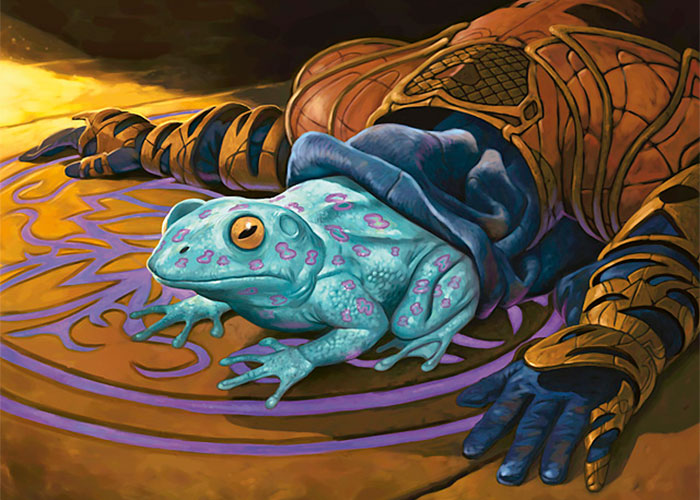
Or, you know, you can just turn their creatures into frogs. 
That works too.

My opinions on the color:

Blue is an interesting color, because it can be both very interesting and very bland, depending on how it is played. In many ways, it can be considered the most powerful color, since you'll often have more cards than your opponents - a huge advantage that sometimes goes overlooked. The green player can drop all of her big stompy creatures onto the field, but then she's got no cards in hand and is playing with the one card she draws each turn; meanwhile, you'll be sitting pretty with six cards in your hand and three more coming each turn, giggling at the fact that you'll be turning the tides soon enough.

However, to me, blue is most boring when played on its own. A mono-blue deck just sits back and draws cards, counters spells, and is often more of a nuisance - a very frustrating nuisance - than any real threat. I find that blue often lacks teeth, so to speak. It can be tough to balance out the need for card advantage and control with the need to, you know, actually drop the other player's life total to zero. (Yes, I know mill decks are a thing, but we're going to ignore that on sheer principle for now.)

That being said, blue is absolutely my favorite color to splash into multicolored decks, my favorite color combination being green/blue. You'll be hearing more about green when I get to that article, but basically green just plays a lot of very large, very scary creatures, like bears and hydras and the occasional unusually-large lizard. But again, green can be boring on its own, so when you combine green's stampede tactics with blue's manipulation, you often end up with a very interesting deck that can adapt to different situations pretty decently while still having the means to actually finish off an opponent.


Plus, when you combine green and blue, you get cool stuff
like human insect wizards. How very exciting!

So to sum up, I think blue can be a really cool color, and it's often great to throw into a deck to add some flair and to keep opponents on their toes. But it does suffer a bit when used on its own, at least in my opinion.


Stay tuned - in two weeks, I will be posting up the next article in this series! To read more about blue's place in the color pie, a series of articles was written by Mark Rosewater, Magic's current head designer, on the subject of the color pie. Which is really where I got a lot of my information about the colors anyway. You can find his article about blue by clicking here.

Friday, November 27, 2015

The Makings of a Character for RPGs

Hey everyone!

Today, I want to talk a bit about character creation, specifically for roleplaying games like Dungeons & Dragons. Character creation is, hands-down, one of my absolute favorite parts of the game, so I'd like to discuss what goes into a character, and what I think is important when it comes to making a good character idea great.

(As an aside, I primarily play Pathfinder, not D&D, but they're almost the same thing. And D&D is easier to type. So I will be referring to D&D throughout this post.

So, those who are familiar with D&D know that there are two main things that go into a character - class and race. Your race, of course, is very simply what species or race your character belongs to. Is your character a human, an elf, or a dwarf? Or even something more unusual, like a tiefling or an aasimar? Your class, on the other hand, is what your character does. If you run into combat with heavy armor and a sword and shield, chances are that your character is a fighter. A ranger, on the other hand, will often stay on the outskirts of a battle with a bow and arrow, while a bard will use her music and magic to support her allies.


Except don't play bards. Bards are useless.

So you might be thinking, "Well, I want to get into the thick of combat without a care in the world and swing a greataxe around, so I'll just play a half-orc barbarian." Which, to be fair, is a perfectly valid way to create a character, and that's all that's really necessary. But when you get into the game, and you find that your fellow players have these rich, flavorful characters, with hopes and dreams and personalities, and your character is just sitting on the sidelines waiting for the next poor, unsuspecting goblin to walk past, you might find yourself bored, frustrated, or disappointed. Now, do you have to write a book detailing your character's backstory and motivations? No, not really. (It'd be really cool if you did though. Kudos to anyone who does so.) But there are definitely real, simple ways to give your characters life and make them interesting. Not every character is going to follow these same steps, but here's a guideline that I think works pretty well for creating a new character.


Step 1: Pick a class.

Some people like to start with their character's race, but personally, I think it makes more sense to start with class. The first thing you should think is "What do I want my character to do?" (I also like to think "What weapon, if any, do I want my character to use?" Some weapons are really cool, and some lend themselves to certain classes and playstyles.) If you want to be an out-of combat expert, relying on skill checks like Diplomacy or Intimidate to get your way, you may want to consider playing a rogue. (Or a bard - I know I mentioned that they're useless, and I will mostly stand by that statement. But that's more for combat situations. And since a big chunk of D&D is combat, I would shy away from playing a character who doesn't do much in combat.) If you'd rather be a support to your other players, providing healing and other benefits to your allies while also smiting your enemies with divine might, a cleric is probably more up your alley. And of course, if you really want to just bash some skulls with a giant club, feel free to grab that barbarian class!

This is also where you can see what other people are playing and try to fill in some gaps. Frankly, to me, this isn't very important. If you've got a party of two rangers and a bard, and you really want to play a ranger, I see no real reason why that should be an issue. However, oftentimes it will be helpful to have some diversity in the party. So if you're playing with three other players, and they have all decided on playing a barbarian, a fighter, and a ranger, you may want to play as a sorcerer, wizard, or cleric to provide some magic to the crew. I find this is a good method if you don't really know what you want to play, but the rest of your players really want to play particular characters.

By the way, if you've never played D&D before, my personal recommendation would be to play a barbarian. They're simple, easy to play, and can be a hell of a lot of fun for everyone in the game.


Step 2: Pick a race.

Now, every race confers different bonuses (and penalties) to your character. An elf character, for instance, will get bonuses to its Dexterity and Intelligence, but a penalty to its Constitution. Meanwhile, a gnome will have increased Constitution and Charisma, but lowered Strength. 


Not this type of gnome. Although I guess there's nothing stopping
you, really.

However, despite these (and other) racial bonuses and penalties, when it comes down to it, I think that race is most important for roleplaying and for flavor. Because, while a vampire-hunting human ranger has a certain compelling feel to it, a vampire-hunting dhampir (which is a half-vampire) ranger has a completely different feeling - still compelling, but for very different reasons. So in my opinion, it is best to pick a race that fits not because "Oh, the ability score modifiers worked well for a barbarian!" but rather because it makes for an interesting story. The player who picked a half-elf because "I was playing a ranger and wanted to put +2 in Wisdom" will likely end up being more bored than the player who picked a half-elf because "My character is the bastard child of a human noble and an elf consort, who was then sent away and was forced to fend for himself in a world that never truly accepted him."

As a disclaimer, there's no problem with picking a race for the benefits it confers to your characters. I do it all the time, as do most players I know. However, I just don't think that should be the only determining factor in picking a race. 


Step 3: Craft a backstory.

This is where you start to go above and beyond in character creation! Some DMs will specifically ask you  for your character's backstory (I know I do). But even if you're not asked for it, it's still really nice to have. Like I said, I don't expect any of my players to write me a novel detailing their character's upbringing, family life, their pet dog Fluffy who was run over by a wayward carriage, and so on and so forth. But again, it's just a matter of injecting a bit of life into your character - they're an entity in the game world, and they didn't just materialize as a level 1 wizard! What caused them to go adventuring? Why are they the class that they are? What are their goals for the future? Just coming up with answers to these sorts of questions can help you play the character and make the game just a bit more vibrant! Plus, the more your DM knows about your character's backstory, the more he or she can incorporate some of those details into the storyline. For instance, if you say that your character is a half-orc who used to run with bandits but had a change of heart and decided to stick to the straight and narrow, when your DM has you run into an old bandit accomplice who tries to get you to join back up with him, that creates an interesting and compelling (and maybe even emotional!) encounter that likely wouldn't have happened if you hadn't created that backstory.


Step 4: Give them some personality!

I'll admit, this was the biggest flaw I had with my first D&D character. I picked out my class, and picked a race to match. Created this really cool, somewhat tragic backstory that provided some insight into why my character acted the way he did, and why he was out adventuring rather than sitting at home. But I gave no thought to my character's personality, so he ended up just being... me. And that's boring. It's a roleplaying game, after all, so why not take the opportunity to roleplay a bit? Are you a really quiet, shy person typically? Try making a very temperamental, often-violent barbarian who drinks a lot and gets into barroom brawls! You may be surprised as to how much fun it'll end up being.

And my advice for this step? Make your character's personality a caricature. A complete exaggeration. I like to pick one character strength and one major flaw. One of my later characters was a really kind-hearted cleric, who believed that everyone had good in them and would always attempt to avoid combat rather than fight needlessly. Character strength? Kindness and a knack for diplomacy. Character flaw? Naivete. She nearly got duped multiple times into giving people money needlessly, and was only stopped by the rest of the party holding her back and saying "Hang on just a hot second, that guy is clearly working with the bandits! How could you not see that?!"

And of course, once you create that personality, try your best to stick to it in gameplay! Even if you, as the player, would love to go exploring that dark crevasse, if you established that your halfling druid is claustrophobic, don't go in there! Make her force the other players' characters in first! Staying true to your character can be tough, but if you can do it, the roleplaying aspects of the game will often end up being much more fun than something like combat.


That's pretty much it! After all that, of course, you've got all the fun stuff like rolling for stats, buying starting equipment, and whatnot. But most of that goes without saying, and I don't think it's as relevant for character creation at its core. Anyway, next time you're starting up a D&D game (or any other RPG, really), try following these steps and see how it works out for you!


EDIT: Two things that I forgot to mention, that are typically fairly important for character creation! One is physical appearance and voice. Generally, I would lump physical appearance in with race, and it can be fairly important for your character as well! Essentially, you'll want your appearance to at least somewhat thematically fit with your character's abilities. If you're playing as a brutish fighter with 18 Strength, for instance, you may not want to be a rat-faced guy who's only 5'3" and 100 pounds. And as for your character's voice, well, that's not entirely necessary for roleplaying, but I personally really like trying to come up with a distinct voice for my characters. (One of my characters, for example, sounds like a deeper-voiced version of Zapp Brannigan.) I think the greatest benefit for giving your character a distinct voice is that it helps set apart the moments in which you're actively roleplaying the character, and the moments in which you're talking as yourself, out-of-character.


Tips from personal experience: if your character sounds like this,
don't expect him to be taken seriously. Ever.

The other thing I want to mention is alignment. Some DMs play very strictly with alignment - for those who are unfamiliar, the two aspects of alignment are Good vs. Evil and Law vs. Chaos. So a lawful good character generally tries to uphold laws and traditions, while also looking out for the greater good. For me, alignment is more of a guideline than anything, since I feel most characters will tend towards a true neutral alignment with leanings toward law, chaos, good, or evil. Plus, alignment is very fluid, in my opinion. I'll likely do a longer post in the future about alignment, but to me, it's just something to keep in mind during character creation, not to be seen as an unerring truth about your character.